A Home Without Barriers: One Family’s Journey to Inclusive Living
How an accessible new home is giving a young girl with a disability the freedom to move on her own terms
In the Siem Reap province, a mother and father are raising four children, two daughters and two sons, on the income from small-scale farming. They grow vegetables, raise animals, and take on seasonal labouring work when they can find it. Between them, they earn around $100 a month. It’s enough to scrape by on food, school costs, and healthcare. It’s not enough to ever get ahead, and certainly not enough to fix a home that was falling apart around them.
A house that wasn’t safe, or accessible, for anyone
For more than five years, the family lived in a 4m x 4m shelter built from low-quality wooden planks, with a roof of ageing zinc sheets and walls patched together from palm leaves and rusted metal. There were no proper doors or windows, so heavy rain and strong winds came straight through.
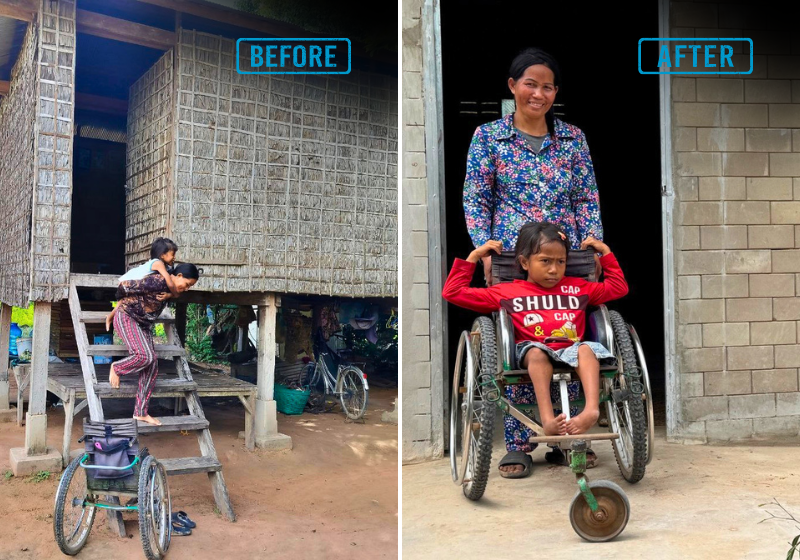
The house wasn’t just unsafe. It wasn’t built for a family with a daughter who lives with a disability.
The home stood high off the ground, with an uneven floor and steep steps. For the couple’s daughter, that meant she couldn’t get in or out on her own, not once, not ever.
“Every day, I had to carry her out in the morning and bring her back in the evening because she couldn’t get in or out by herself,” her mother said. “Inside the house, moving around was very hard for her.”
What her mother wanted was something simple, and something she’d never had the means to give: “I dream of a safer home where my daughter can move freely and go outside on her own.”
A house designed around what the family actually needed
In early July 2025, the family was selected by the PASSA group – a community team formed through a Participatory Approach for Safe Shelter Awareness – and recommended to Habitat for Humanity Cambodia for housing support. Given the family’s circumstances, they were approved for a new brick home, designed from the ground up to be accessible.
“A new home will provide us more than shelter,” her mother said. “It will help my family live healthier, earn a stable income, and support my daughter’s education.”
What independence looks like now
Today, the family’s daughter moves in and out of the house in her wheelchair, on her own, and gets her school materials ready without anyone’s help.
For her mother, that change has rippled outward. “Now, I have more time to grow vegetables and raise chickens for food and income, because I no longer need to help my daughter every time she moves around.”
It’s a small sentence with a big meaning: a home built for one person’s independence gave the whole family more room to build a stable life.
“Your help has changed our lives,” her mother said. “I hope many more families can experience the same support.”
Habitat for Humanity Cambodia works alongside families and local partners like PASSA to build safe, accessible homes for people who need them most. If you’d like to learn more about our work in Cambodia or find a way to get involved, get in touch with our team, we’d love to hear from you.
These projects receive support from the Australian Government through the Australian NGO Cooperation Program (ANCP) and are in partnership with our implementing partner Habitat for Humanity Cambodia.